A Köhler illumination is a way to create uniform illumination out of a non-uniform source. Most notably, Köhler illumination makes very little use of diffusers, thereby preserving almost all of the source’s optical power. This article shows how to design such an illumination scheme and gives tips and tricks on how to optimise the design.
At its heart, the Köhler illumination is a collimator. Köhler illumination uses the fact that the image of any object, no matter how non-uniform the object, will become perfectly uniform once this image is entirely out of focus. And to bring an image out of focus, one simply needs to focus it to infinity. The concept is perhaps easiest understood by imagining a non-uniform light source like an LED and an object that needs to be uniformly illuminated, like a reticle. The reticle can be uniformly illuminated with this non-uniform LED if one creates a perfectly defocused image of the LED, with the pupil at the position of the reticle. Like this: In this image, light emitted by the LED is focused on the reticle. However, the rays that form an image at the reticle plane (e.g., the rays converge there) do not form an image at the LED plane. At the LED plane, the image is perfectly defocused (e.g., the rays are parallel to each other). That means that no feature of the LED chip, no matter how non-uniform, will be projected onto the reticle plane. Those features are simply out of focus and meld into a uniform blur – which is precisely what this illumination scheme is all about. The lens that brings the light from the LED to the reticle is called the “condenser lens” and is typically a high-powered asphere or aplanat. Lens vendors typically market high-powered elements as condenser lenses. This perfect defocus and the collimator needed to create it are the key components of the Köhler illumination. Once this part is understood, one can first set up the paraxial and, ultimately, the actual lens system. After defocusing the LED image, the next step is deciding how the reticle should be illuminated. The chief rays coming to the reticle can either be converging, parallel or diverging and, depending on the task, the illumination might be required to be either one of these three cases. A lens supporting either case is called “entocentric”, “telecentric”, or “hypercentric”, respectively, and the lens can be adapted to either case by changing the distance between the LED and the lens. Like this: In most cases, the telecentric case will be relevant, and this is the case that this article will discuss. However, there are cases where an entocentric or a hypercentric illumination is required. The formulas and approaches given in this treatment can be adapted for these two cases. In a telecentric system, the focal length The reticle height (1) 
Setting up the Lens System

 of the lens links the height of the reticle
  to the LED emission angle
  and the marginal ray angle
  to the LED emitter size
  . Like this:
 is the field of the optical system, and by controlling how large a reticle can be illuminated, one controls the field of the optical system. The equation that links the field to the LED emission angle is

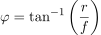
The marginal rays will form the pupil of the system, and by controlling the marginal ray angle , one controls the pupil of the system. The larger the marginal ray angle, the larger the system pupil. The equation that links the marginal ray angle to the LED emitter size is
(2) 
From these equations, it is apparent that not every LED can illuminate any given reticle. A given LED might have too small a field of view (e.g. too small emission angles) or be too small in size (e.g. too small emitter). There are ways to trim down a too large LED field of view, but there are no ways to increase it. The same applies to the emitter size; it can be made optically smaller by blocking parts of its area, but it cannot be made larger. Optically speaking, the etendue of the LED needs to be equal to or larger than this of the reticle.
With equations Eq. (1, 2) established, it is now possible to pick a fitting LED and lens to build the Köhler illumination. And a fitting LED will typically have a slightly larger field of view than needed and an emitter slightly larger than needed. And picking a slightly too good LED is a reasonable approach to compensate for tolerances when building the system. However, having too much field of view or emitter area leaves one with too much light in the system. And this extra light will create stray light and, with it, non-uniformities in the light field at the reticle plane.
This stray light can be removed by inserting pupil and field stops into the system. With these stops, the LED’s light field can be shaped and fitted to the reticle. Unfortunately, the current single-lens illumination does not permit to add either stop to the system. Thus, one must add elements to the system that provide these stops. A simple way to create the necessary conditions to get stops is by adding a unit magnification relay lens between the reticle and condenser lens. Like this:

With the relay lens added, the Köhler illumination is complete. It is a combination of a relay and a condenser lens, projecting a perfectly defocused image of an LED onto a reticle. A pupil and field stop shape the LED’s light field to match the reticle’s etendue perfectly.
One should note that the relay lens need not necessarily be a unit magnification lens. The unit magnification lens is simply convenient to add since it does not change the optical power of the system while still providing access to the stops. In a typical Köhler illumination design, it is common to distribute the required optical power over both the relay and the condenser lens. In such a case, the relay lens no longer has unit magnification. The Köhler illumination of the next section, a tried and tested design, distributes the optical power over both the relay and the condenser lens.
Example
This example shows how a typical Köhler illumination design works. A reticle with the specifications
- Reticle Size: 15 mm rectangular (=7.5 mm field)
- Telecentric Cone Angle: 5° FFOV (=2.5° marginal ray angle)
should be uniformly illuminated with the Thorlabs mounted LED M530L4 [1] with the specifications
- Emitter Size: 1×1 mm rectangular (=0.5 mm Source height)
- Field of View: 80° FFOV (=40° source emission half-angle)
The task is to design the appropriate Köhler illumination.
The first step is to calculate the required optical power of the lens. Here it is helpful to understand how the lens power choice influences the LED requirements. For example, a higher-powered lens will require the lens to have a large field of view but a small emitter size. Conversely, a low-powered lens will require the LED to have a large emitter size but only a small field of view. A graphic representation for this particular example looks like this:

The Thorlabs LED has a small sensor size but a large emission angle. Thus, one must use a high-powered lens. Given the restrictions of the LED, a focal length of roughly 10 mm is appropriate for this task:

A lens of 10 mm focal length requires an LED with a sensor of roughly 0.45 mm source height and 37° emission half-angle. The last step is placing the glass elements and optimising the design. There are multiple ways of placing the elements, and different approaches might be more or less successful. This approach is one way to do it:
- Place the pupil stop behind the reticle
- Place either
- a low-powered singlet OR
- an achromatic doublet OR
- an aplanat
- Place a few low-powered singlets behind the pupil stop until they produce an image
- Put the field stop at this image location
- Place either
- a high-powered asphere OR
- a high-powered aplanat
- Increase or reduce the optical power in the system until the desired optical power is reached
The design achieved with this recipe (using these low-cost standard elements [2], [3], [4]) is:

There are other ways to produce a Köhler illumination, but this is one way to do it. This particular design is relatively low in aberrations and comes close to the paraxial approximation. It requires the LED to have an emitter of about 0.98 mm in length and emit at 78° FFOV. This design then preserves almost all optical power of the LED and lets very little go to waste at the stops.
Improving Uniformity
A Köhler illumination creates excellent uniform illumination with only a few imperfections. However, some tasks, like optical metrology, require perfect uniformity. In such a case, it makes sense to add weak diffusers to improve uniformity even further. One kind of suitable diffusers are weak holographic diffusers, like the ones from Edmund Optics [5]. They make an already excellent uniform illumination near-perfect at minimal optical power loss.
Depending on whether the pupil or the field needs to be more uniform, the diffuser must be placed at different positions inside the lens. If the pupil needs to become more uniform, the diffuser must be placed between the field stop and the condenser lens, as close to the field stop as possible. If the field needs to become more uniform, the diffuser must be placed as close as possible to the pupil stop, facing the LED-side of the setup.
References
- [1] Thorlabs: M530L4
- M530L4 – 530 nm, 370 mW (Min) Mounted LED, 1000 mA
- Accessed: 2022-07-31
- https://www.thorlabs.com/thorproduct.cfm?partnumber=M530L4
- [2] Thorlabs: LA1251-A
- LA1251-A – N-BK7 Plano-Convex Lens, Ø25.0 mm, f = 100 mm, AR Coating: 350 – 700 nm
- Accessed: 2022-07-31
- https://www.thorlabs.com/thorproduct.cfm?partnumber=LA1251-A
- [3] Thorlabs: LA1253-A
- LA1253-A – N-BK7 Plano-Convex Lens, Ø25.0 mm, f = 200 mm, AR Coating: 350 – 700 nm
- Accessed: 2022-07-31
- https://www.thorlabs.com/thorproduct.cfm?partnumber=LA1253-A
- [4] Thorlabs: ACL1512U-A
- ACL1512U-A – Aspheric Condenser Lens, Ø15 mm, f=12 mm, NA=0.61, ARC: 350-700 nm
- Accessed: 2022-07-31
- https://www.thorlabs.com/thorproduct.cfm?partnumber=ACL1512U-A
- [5] Edmund Optics: #47-994
- 5° Diffusing Angle 25mm Dia Mounted
- Accessed: 2022-07-31
- https://www.edmundoptics.com/p/5deg-diffusing-angle-25mm-dia-mounted/8195/


4 Comments
Yadong · 2023-10-27 at 13:33
Hello Thomas,
Thank you for writing down your thoughts for this design. I have spent some good time trying to catch up with your flow, and I really enjoy it.
I got a question that I want to discuss if possible:
Let’s say in the design the reticle has a specified illuminance 30,000 lux, any tricks to estimate the required LED luminous flux in lm? I saw you mentioned the concept of etendue, my feeling is to use the conservation law try to estimate?
tkerst · 2023-10-29 at 18:32
Hello Yadong,
Yes, you’re on the right track. Etendue is indeed the key concept to use here. For the reticle, the approximation of its etendue can be given by the formula:
(15.0 mm ⋅ 15.0 mm) ⋅ 2 ⋅ π ⋅ (1 − cos(2.5 °)) ≈ 1.35 mm² sr
On the other hand, for the LED, the etendue can be approximated with:
(1.0 mm ⋅ 1.0 mm) ⋅ 2 ⋅ π ⋅ (1 − cos(40.0 °)) ≈ 1.47 mm² sr
From the above calculations, it becomes clear that the LED etendue is roughly 10% larger than the reticle etendue.
Now, to get the LED luminous flux, you calculate the reticle luminous flux with
30 000 lx ⋅ (15.0 mm ⋅ 15.0 mm) ≈ 6.75 lm
on which you add the 10 % etendue difference to give you the required minimum LED luminous flux of 7.43 lm.
To ensure the effectiveness of the design and to account for potential diffusers you might incorporate, I’d recommend adding at least 20% on top of this. Therefore, to be on the safer side, I’d recommend using an LED with at least 9 lm luminous flux.
I hope this clears things up. Let me know if you have any further questions or if there’s anything else I can assist you with :)!
Yadong · 2023-10-30 at 17:33
Hello Thomas,
Thank you for the explanation. Your method works well as a guide to start the LED selection. I want to further discuss two topics if you don’t mind.
(1) Based on the last system layout, I assume that you started the design from Left to Right using the reticle as the imaginary uniform source? My way to interpret this diagram from LED (right) to reticle (left) is that:
(a) The LED forms an out-of-focus image at the field stop after the aspheric lens. The field should be, in principle, most uniform at the field stop. If let’s say we want to adjust the illumination area on the reticle, this field stop is a good spot to place the diaphragm or a slit.
(b) Then this field stop is imaged onto the pupil stop, this time I think it should be an enlarged LED image on this field stop. If we need to tune the intensity, I would say this pupil stop is a good place.
(c) Lastly, the LED image at the pupil stop becomes out-of-focus again on the reticle which gives what we want – uniform light distribution.
Whether my understanding is correct? I guess my thoughts are kind weird…
(2) In some cases, the working distance (from last element to reticle) needs to be quite large. Whether the last singlet should be removed or replaced to achieve long WD?
I accidentally found your site about this illumination design. It offers very good view on this topic. I recall I read from somewhere that you should always note down things that you learn or do and share it online. It can always help someone. Thank you.
tkerst · 2024-05-02 at 17:07
Sorry for the super late reply.. somehow the comment slipped through my fingers.
(1) Yes, I imagine the reticle to be an imaginary light source.. makes things much easier
(a) Correct, the image must be perfectly out of focus at the LED for the LED chip image to not show up at the reticle; and yes, if you want to modify the field, say, with diaphragms, then the field stop aperture is great spot.
(b) The field stop is not quite imaged onto the pupil stop. The field stop is imaged onto the reticle, and the LED chip is imaged onto the pupil stop. And yes, the intensity (but also the pupil size) is altered by altering the pupil stop size
(c) Your understanding is absolutely correct!
(2) When people refer to working distance they often mean the distance between the actual tested object and the objective lens. In the above drawings, these things would be to the left or the reticle and they are not shown here. However, if you want to increase the distance between the reticle and the field lens, I would use a long focal length lens; singlet will do.