Optical metrologists need homogeneous light sources. Without them, it is difficult to measure the quality of optical systems accurately. Though commercial solutions are an option, they are often expensive. Their high prices are usually not a problem if one needs only a few of them. However, if they are parts of mass-produced products, then their high prices are a problem. In such cases, it is preferable to build one’s own customised light sources. This post shows how to design such a customised light source and uses an easy-to-follow example to demonstrate all steps in a complete optical design. Only standard components and simple manufacturing techniques are used.
A typical problem in optical metrology goes something like this: Take a few LEDs emitting at different wavelengths and arrange them such that every single one of them evenly illuminates a given object. The LEDs have to work in concert, too, thereby mixing their light and creating illuminations of varying colours. Finally, the object itself is an aperture of simply geometry etched into a plate. It could look something like this: Here, the aperture is the central hole, and it is the object to be illuminated. The more evenly illuminated it is, the easier detectable imperfections in any system that tries to produce its image become. Homogeneous illumination means that the luminance of the rays passing through the hole must not vary within an angular range The luminance can vary in both the spatial and the angular domains. If it varies over the spatial domain, then the illumination is said to be spatially inhomogeneous. If it varies over the angular domain, it is said to be angularly inhomogeneous. Here again, it is perhaps easiest to understand the concept with the help of some drawings: Typically, it is possible to achieve homogeneous illumination either over wide angles or large diameters, but not both simultaneously. Typically illuminations with large diameters are prone to spatial inhomogeneity through insufficient diffusion. Conversely, illuminations with large angles tend to be prone to inhomogeneity through vignetting. This post assumes that the illumination requires only small angles (a few degrees) but large diameters (many millimetres). The design process, though, is adaptable to cases with wide angles and small diameters. Therefore both cases are covered by the post. The optical design starts with the diffusing element, the integrating sphere, that merges the light of all LEDs into one single light source. There are two reasons for using an integrating sphere. First, it mixes the light emitted by multiple LEDs. As long as the sphere’s wall material acts as a Lambertian diffusor for all involved wavelengths, then the sphere merges the light of all its sources into a single homogeneous light field. Second, an integrating sphere is a perfect diffusor. It renders the spatial distribution of its inputs irrelevant. The light an integrating sphere emits is only informed by the spectrum of its inputs. Therefore, using an integrating sphere is a good design choice, even when using only a single LED. The reason is that LEDs are notorious for continually changing their emission characteristics. They change it with current, with temperature, with age, etc. By using an integrating sphere, one need not think of any of those changes; the sphere outright nullifies their impact. So, assuming that in this example, one has to use one green-emitting and one red-emitting LED, a simple integrating sphere of radius This design uses three ports: one port for each LED and one exit port of diameter The last parameter characterising the sphere is the material reflectance (1) (2) 
![\left[-\varphi, \varphi\right]](https://huchma.fi/wp-content/ql-cache/quicklatex.com-445c52f989d898b57acd54c874b8522f_l3.svg "Rendered by QuickLaTeX.com") over its entire diameter
over its entire diameter  . It is perhaps easier to understand the concept when put into a drawing:


Designing the Integrating Sphere
 could look something like this:
 . Whereas the LED ports take their diameters directly from the LEDs’ dimensions, the exit port diameter is must be chosen. And choosing both the sphere radius and the exit port diameter is a significant part of the optical design.
 . The more reflective the material, the more internal diffusive reflections
  an incoming ray of light undergoes on average before leaving the sphere through the exit port. The number of reflections is related to the reflectance via

 is the port-free surface area fraction, given with

The more often a ray reflects, the better mixed and diffuse the light field inside the sphere becomes. Thus, naturally, one aims to have as many reflections as possible. However, for most practical scenarios, an average of three reflections is sufficient, and ten or more reflections already bring a sphere to scientific-grade quality. Commercial solutions tend to aim for ten or more reflections and use materials like barium sulfate, spectralon or even gold dust to achieve that. It is easy to see how those solutions get to their often steep prices.
A sphere that only has to mix and diffuse light of a few LEDs does not need ten or more reflections. It certainly does not need spectralon or even gold dust. Instead, it will do fine with cheap off-the-shelf polymers like ABS. When formed into a sphere, these polymers become Lambertian reflectors and easily bring a sphere to three or more reflections. Moreover, they are easily shaped and reshaped using nothing more than a 3D printer. Thus, polymer integrating spheres are significantly cheaper and quicker to manufacture than their more traditional gold-dusted counterparts. For those reasons, self-made polymer integrating spheres are the obvious choice when building a sphere at home.
The next step would be to choose both the sphere radius and the exit port diameter. However, those two parameters are influenced by the lens system that guides the light emitted by the sphere to the object. Thus, the next step is to design the lens system and then decide on sphere radius and exit port diameter.
Designing the Lens System
When putting sphere, yet-to-be-designed lens system and plate together, the optical design looks like this:

Before starting to draw lenses, it is worth noting that the integrating sphere significantly simplifies the design. One need not worry about relative illumination and luminance distributions. So long as the light emitted by the sphere reaches the object (in all relevant angles and positions), then the illumination will be homogeneous. And since it is non-imaging optics, one need not worry about aberrations, either.
The lens design becomes simpler still if one turns the optical system around and pretends that one has to deal with homogeneous collimated light with a field angle  that enters an aperture of diameter . By focusing this light onto the exit port, one has made sure that all light enters the sphere. In such a scenario, the plate becomes both aperture stop and entrance pupil, the exit port becomes both field stop and focal plane, and the coma ray is the ray that enters the aperture stop at the very edge with the field angle . Upon reaching the focal plane, it has assumed the coma ray angle
  . Then, the flipped optical system looks like this:

From this point onwards, it is reasonable to give field angle and aperture stop diameter some typical numbers. Without them, it is pretty pointless to do a proper lens design. Let them be 6° and 10 mm, respectively. With these numbers at hand, it is possible to determine how well the lens system can focus the beam. And one aims to have a small focus spot size. After all, a smaller focus spot size means having a smaller exit port diameter, which means having more reflections.
The two effects limiting the spot diameter size to a certain minimum are etendue and sphere geometry. They define how much light can bend before no longer contributing to the illumination. It is perhaps easiest to understand how both limitations come about using the coma ray angle in these simple drawings:

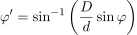
The first limit, the etendue limit, is a hard physical limit. It states that smaller focus spot sizes result in larger coma ray angles . Thus, once the coma ray angle approaches 90°, the physically possible minimum focus spot size is reached. Choosing smaller spot sizes will inevitably cause vignetting. The etendue relates coma ray angle and spot size with the equation
(3) 
The second limit, the geometric limit, is not a physical limit. It is the sphere geometry itself that imposes it. It is the recognition that even if a ray intersects with the focal plane and enters the integrating sphere, it must ultimately intersect with the sphere wall still. If it does not and intersects with a port instead, then this ray’s luminance will be different from those hitting the wall, thereby creating inhomogeneity. For this particular integrating sphere, the arrangement of the ports restricts the maximum coma ray angle to about 35°. And only an illumination scheme with a focal sport diameter larger than 1.478 mm can guarantee that every ray hits the sphere wall.
Given these limitations, it is sensible to choose a 2 mm wide exit port diameter. It is small enough not to impact the number of internal reflections, and it is sufficiently large to neither have etendue or geometric limit violated. The next step is to calculate how strong a lens must be to bend a 10 mm wide collimated beam incident with a 6° field angle to create a 2 mm focus. The effective focal length (EFL) of such a system is given by
(4) 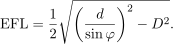

With an aperture stop diameter of 10 mm and EFL of 8.156 mm, it is clear that the lens system has to consist of at least two individual strong lenses. Since this design is entirely unconcerned about aberrations, one can pick some off-the-shelf plano-convex lenses from Edmund Optics and optimise their placement to achieve a 6° field angle. This 12 mm [1] and this 6 mm[2] lens, for instance, do just fine. And the not-too-complicated optimised design might look something like this:

Its f-number of 0.81 makes it a fast and, therefore, efficient lens design. This result is especially satisfying in light of the fact that it only employs affordable catalogue lenses. With the lens design finished, it is sensible to finalise the integrating sphere design.
Complete Solution and Unit Price Estimate
With the lens system dictating the exit port diameter, it remains to find an appropriate sphere radius. Assuming an LED port diameter of 3 mm, a reflectivity of 0.85 and 3 internal reflections, the sphere radius must be at least 6 mm. Larger radii are possible but potentially reduce light intensity. Smaller radii are not possible since they risk homogeneity. With this last bit of information obtained, the complete illumination system looks like this:

The unit price estimate (ex plate, ex LEDs, ex design) is:
- 12 mm Lens [1]: 28.50 €
- 6 mm Lens [2]: 26.00 €
- Optomechanics: ~10.00 €
- Sphere Material: ~5.00 €
- Assembly: ~5.00 €
- Total: ~74.50 €
With an estimated unit price of less than 100.00 €, DIY polymer sphere illuminations are very competitive compared to their commercial counterparts. Though such simple designs lack features like computer-controlled port-contraction, they certainly make up for that with their sheer price advantage.
References
- [1] Edmund Optics
- 12.0mm Dia. x 12.0mm FL, Uncoated, Plano-Convex Lens
- Accessed: 2021-07-27
- https://www.edmundoptics.com/p/120mm-dia-x-120mm-fl-uncoated-plano-convex-lens/5574/
- [2] Edmund Optics
- 6.0mm Dia. x 10mm FL, Uncoated, Plano-Convex Lens
- Accessed: 2021-07-27
- https://www.edmundoptics.com/p/60mm-dia-x-10mm-fl-uncoated-plano-convex-lens/38862/


0 Comments